


A practical framework for governing agentic identities — before they govern themselves.
Where We Left Off
In our Executive Brief on Agentic Dark Matter, we explained how AI agents represent a new class of actor that fits neither the human nor the non-human identity model. Treating them like machines grants dangerous levels of standing privilege. Treating them like humans overwhelms manual change management. Ignoring them turns them into agentic dark matter — unmanaged identities operating inside your environment, invisible to governance.
This Buyer's Guide addresses what comes next: what an identity model that actually works for Agent AI looks like, and how to build it.
The goal isn't to slow down AI agent adoption. It's to build the identity foundation that makes safe, compliant deployment possible.
The Four Pillars of an Extended IAM Model
An IAM model that works for Agent AI must be built on four interconnected capabilities:
Pillar 1: Delegated Identity in Practice
The core insight is that an AI agent is not a standalone identity. It is a proxy for a human. That means every agent needs:
- Its own registered identity, to which actions can associated
- Durable linkage to the human prompter on whose behalf it acts
- Defined scope and duration of authority delegation
- A chain of custody that audit and compliance teams can review
This has practical implications for implementation. Every AI agent deployed in the enterprise — whether built internally or procured — should be enrolled in identity governance with the same rigor applied to a new employee. That means a registered identity, a defined prompter, and a documented scope of function.
Agents that cannot be enrolled — because they were deployed without oversight, or because the tooling to govern them doesn't exist yet — are by definition agentic dark matter and pose severe cyber, compliance and even business continuity risks.
The enrollment question is simple: can you produce a list of every AI agent operating in your environment right now, with its owner, its authorized scope, and its access history? If not, dark matter is already present.
Pillar 2: Dynamic Privilege in Practice
Standing privilege is the original sin of non-human identity management. It was acceptable for deterministic machines because their function never changed. It is unacceptable for agents because their function changes with every prompt, and their training encourages them to seek out any shortcut in the name of efficiency.
A dynamic privilege model for agents looks like this:
- The prompter submits a task to the agent.
- The system evaluates what access that task requires and whether it should be authorized — based on the declared task scope and prompter permissions.
- The agent is granted just-in-time access, scoped to that task, for the duration of the task.
- Access is automatically revoked when the task completes or times out.
- Every access grant and every action taken under it is logged and attributed to the delegation chain.
This model requires two things the current IAM stack typically lacks: real-time context about what an agent is trying to do, and the ability to make and enforce granular access decisions at machine speed.
Dynamic privilege isn't just a security improvement. It's the only model that can scale with agentic AI deployment without overwhelming governance teams.
Pillar 3: Continuous Observability
Most IAM tools operate at the access layer — they manage what identities are declared to have. But there is a persistent gap between declared access and actual behavior. That gap is where risk lives.
Observability for agentic identities means visibility at the application layer — where authorization decisions are actually executed, where data is actually accessed, and where an agent's behavior either stays within its intended scope or doesn't.
Effective observability for agents requires:
- Real-time activity monitoring — not periodic log review
- Behavioral anomaly detection — flagging actions that fall outside the defined task scope or granted permissions
- Cross-system visibility — agents move across applications; observability must follow them
- Attribution to the delegation chain — every action linked back to the human prompter with intent -> tool-> action -> business context insight
The challenge is that most enterprise observability tooling was built for human-speed activity and simply logged actions rather than intents, outcomes and context. Agents operate orders of magnitude faster and much more creatively. Observability infrastructure must match that speed and intent to be effective.
Logs tell you what happened, as discrete events. Observability tells you what is happening, in context. For AI agents moving at machine speed, only one of those is actionable.
Pillar 4: IAM Hygiene as the Foundation
Delegated identity with dynamic privilege plus continuous observability are powerful — but they are only as good as the identity guardrails within which they operate. Unmanaged applications, stale permissions, orphaned accounts, alternate access paths, excessive permissions and absent controls all become identity exposures that AI agents can and will exploit.
Strong IAM hygiene requires:
- A complete and accurate inventory of applications and identities — human, non-human, and agent
- Regular cleanup of stale or excessive permissions, as well as local, orphaned or dormant access
- Documented and enforced least-privilege baselines as the starting point for dynamic grants
- Strong identity controls such as encrypted or vaulted credentials, multi-factor authentication and more
- Implemented best identity practice such as login monitoring and rate limiting, step-up authentication, account lockout and similar
In reality, most enterprises have significant hygiene debt (often classed as Identity Dark Matter)- accumulated over years of “shortcuts” that undermine the foundation of the IAM program. After deploying agents at scale, that debt becomes an active liability. Cracks become fissures, fissures become chasms. Agents will find every gap.
IAM hygiene has always mattered. With AI agents in the environment, it's no longer a housekeeping task — it's a security prerequisite.
Current State vs. Extended Model: A Summary
Where to Start
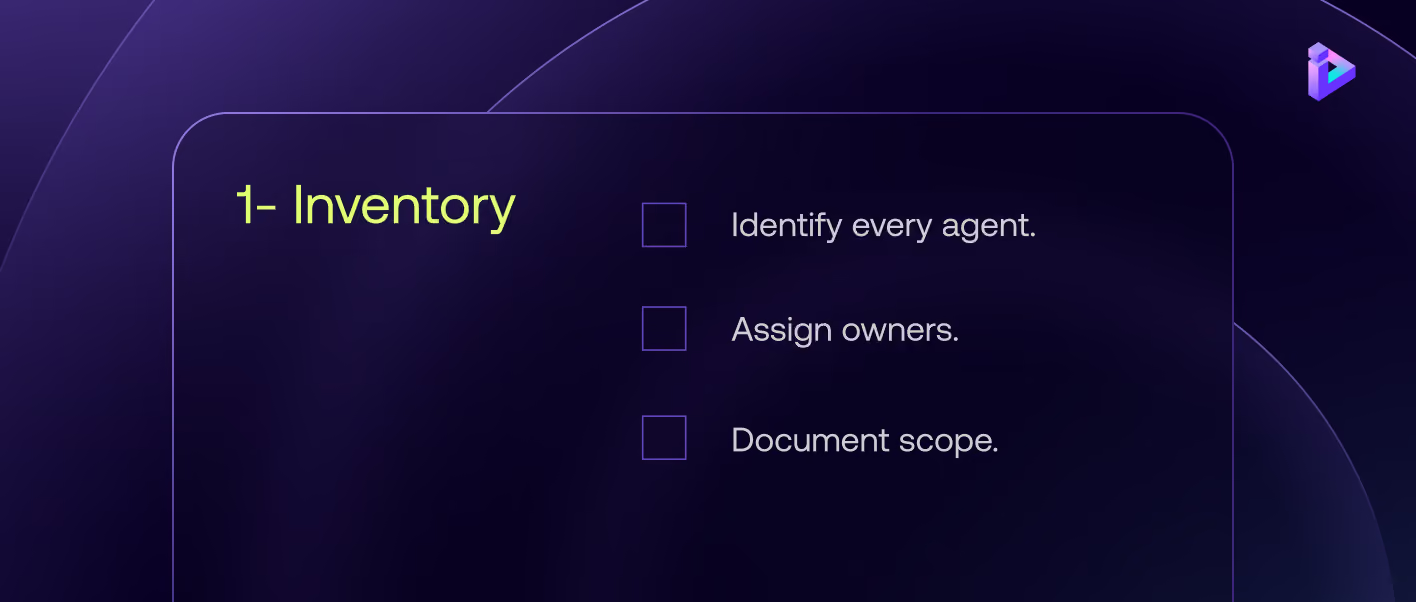
The extended IAM model described in this brief is not a multi-year transformation project. It can be phased. Here is a practical starting sequence:
- Inventory: Identify every AI agent currently operating in your environment. Assign owners. Document scope.
- Hygiene: Remediate the highest-risk identity gaps — stale permissions, orphaned accounts, over-privileged service accounts that agents could inherit or exploit.
- Observability: Instrument your highest-priority environments for real-time agent activity visibility. Start where agent deployment is densest.
- Dynamic privilege: Pilot just-in-time access controls for new agent deployments. Use observability data to define appropriate task scopes.
- Scale: Extend the model across the environment as confidence and tooling mature.
Understanding, let alone maintaining, identity security posture across any large organization- with its diverse and always evolving application estate- is a constant challenge.
Remember, that estate includes applications created by different developers, at different times- when technology, regulations and cyber risk were different- and even by different organizations if acquisitions were part of the growth strategy.
Any approach, but especially an automated one, that provides a comprehensive and accurate view into the true state of identity, is hugely valuable to CISOs. Especially when it can surface all of the identity flows coded in each application. We know that many threat actors are adept at finding the alternate or forgotten ways into our organizations, and this report highlights the most common exposures we need to look out for (and address).
The insights shared here are instructive for every cyber security professional.

and former CISO
- 48%
Storage of hard coded, cleartext credentials or use weak hashing
- 44%
Authentication paths that bypass the corporate Identity Provider
- 40%
A lack of baseline controls like rate limiting, account lockout and password complexity
- 37%
Outdated or non-standard authentication protocols
- 37%
of applications failed to enforce access controls fully or at all
Checklist to Identify the Top Missing Identity Controls
Download Checklist

Discovery and Gap Analysis: Continuous Visibility Beyond the Known
Orchid delivers continuous, telemetry-driven visibility into identity implementations across all automatically discovered applications regardless of geography, technology stack, or existing compliance knowledge. This capability empowers organizations to uncover both commonly missed controls and hidden identity mechanisms that conventional audits and reviews often fail to detect.

No Prior Context or Manual Input Required
Unlike traditional assessment and onboarding processes that rely on interviews, documentation, or involvement from app owners or developers, Orchid's analysis is entirely autonomous. It requires no prior data points, tribal knowledge, or manual onboarding, making it ideal for large, fast-changing environments.

Save Time, Save Money — Harness Your True Identity Landscape
By eliminating the need for human-led discovery, context-gathering, or code walkthroughs, Orchid significantly reduces the time and cost of identity posture management. It accelerates both discovery, gap analysis and remediation cycles including onboarding, freeing up security teams and engineering resources to focus on higher-impact work while utilizing the organizational siloed identity tools.

Checklist, Fully Covered
Our platform aligns directly with the Checklist to Identify the Top Missing Identity Controls and many more providing instant, actionable insights on where your applications stand and what needs attention.
 January 2025
PowerSchool Breach
Cybercriminals reportedly used stolen credentials to access a support portal that lacked MFA, exposing sensitive student and parent data.
 March 2025
Jaguar Land Rover Incident
A threat actor used stolen credentials to infiltrate the company’s Jira system, allegedly stealing over 700 internal documents.
 April 2025
Verizon Data Breach Investigations Report
Verizon Identifies Stolen Credentials as Top Breach Entry Point In their latest report