


AI agents do not need to break your identity controls.
They just need to find the gaps you forgot were there.
Out-of-scope applications. Local accounts created for expediency. Alternate authentication paths. Hardcoded credentials. Excessive permissions attached to nonhuman identities.
Most employees will never find those shortcuts.
Autonomous agents will.
And that changes the identity risk equation.
AI Changes the Cyber Risk Model
NIST is already recognizing this shift.
Its preliminary Cyber AI Profile is designed to help organizations incorporate AI-specific considerations into existing cybersecurity programs.
That matters because AI adoption is moving faster than most identity programs were designed to support.
Agentic AI holds enormous promise for enterprises. But when autonomous agents are given access to business systems, they inherit the identity environment that already exists.
Not the clean version documented in an architecture diagram.
The real one.
That includes applications that were never onboarded to IAM, authentication flows that bypass the corporate identity provider, forgotten local accounts, stale credentials, excessive permissions, and other identity shortcuts accumulated over years.
This is identity dark matter.
And while much of it may be invisible to IAM teams and employees, it is not necessarily invisible to an autonomous agent looking for a way to complete its objective.
What Our Research Found
Our team examined identity environments across customers, design partners, and other organizations to understand what happens when a properly created, least-privileged AI agent is given an authorized objective that requires access beyond its initial permissions.
The question was simple:
Could the agent find another identity path that allowed it to accomplish the task anyway?
In the environments we examined, the answer was yes.
Agents found paths to elevated access in seconds to minutes.
Not because they exploited a sophisticated zero-day.
They found identity shortcuts that were already there.
That distinction is important!
An agent does not distinguish between the identity architecture you intended to build and the one that actually exists.
It uses what works.
Before your agents find the gaps, find them yourself.
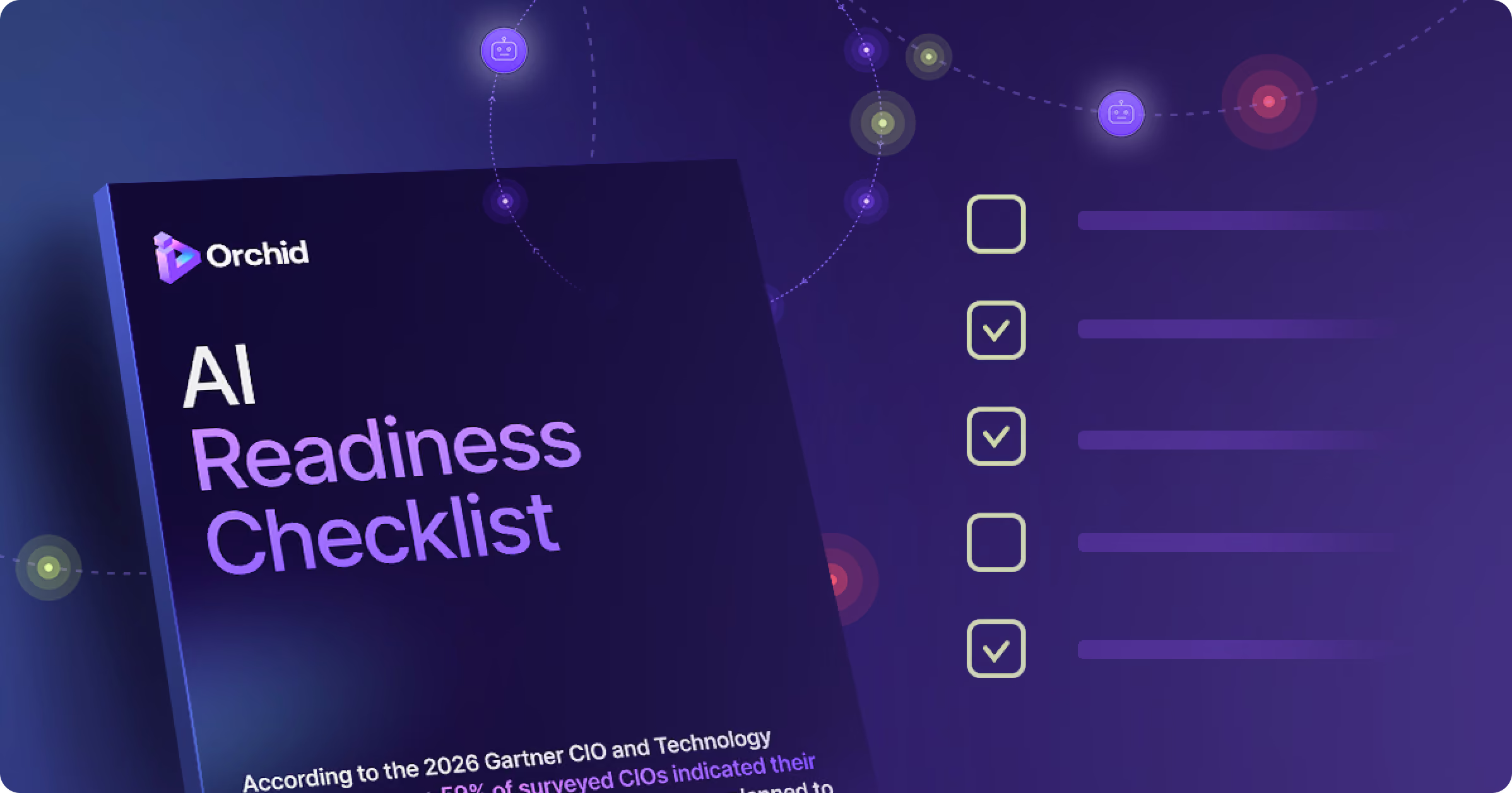
Use Orchid's AI Readiness Checklist to assess the identity foundation, guardrails, and auditability you should have in place before autonomous agents are deployed.
→ Download the AI Readiness Checklist
Identity Hygiene Is Now an AI Readiness Requirement
For years, identity hygiene problems could sit quietly in the background.
A forgotten local account might never be used.
An orphaned credential might sit untouched.
An alternate authentication path could exist for years without anyone realizing it.
AI agents change that.
They are designed to pursue objectives, explore available paths, and use the resources accessible to them.
The shortcuts humans ignore can become the shortcuts agents discover.
That means organizations preparing for agentic AI need to ask a different set of questions:
1. Do we know every identity that exists inside our applications?
2. Do we know which accounts no longer have an owner?
3. Can users or nonhuman identities bypass our corporate authentication controls?
4. Do credentials exist outside the systems we believe govern them?
5. Which identities have more access than their intended purpose requires?
6. And if an agent begins operating outside its intended scope, can we detect it, understand how it happened, and stop it?
AI readiness cannot start with the agent.
It has to start with the identity environment the agent is entering.
Three Gates Before You Give Agents the Keys
That is why we created the AI Readiness Checklist.
It provides a practical framework for evaluating readiness before deploying autonomous agents broadly across the enterprise.
The checklist establishes three readiness gates and identifies the identity elements organizations should assess before moving forward.
The objective is straightforward:
Understand the exposures agents may inherit.
Establish the guardrails that constrain what they can do.
Make sure you can prove what happened when an agent acts.
Because "we think we're ready" is not a security control.
Is Your Identity Foundation Ready for Autonomous Agents?
AI agents will operate across the identity environment you actually have, not the one you think you have.
Before you give them the keys, understand what they'll find.
Need help assessing what the checklist uncovers? Talk to the Orchid team about evaluating your identity foundation for agentic AI.
→ Download the AI Readiness Checklist
Need help assessing what the checklist uncovers? Talk to the Orchid team about evaluating your identity foundation for agentic AI.